 Micronesia Sun Bright News from the Deep Pacific
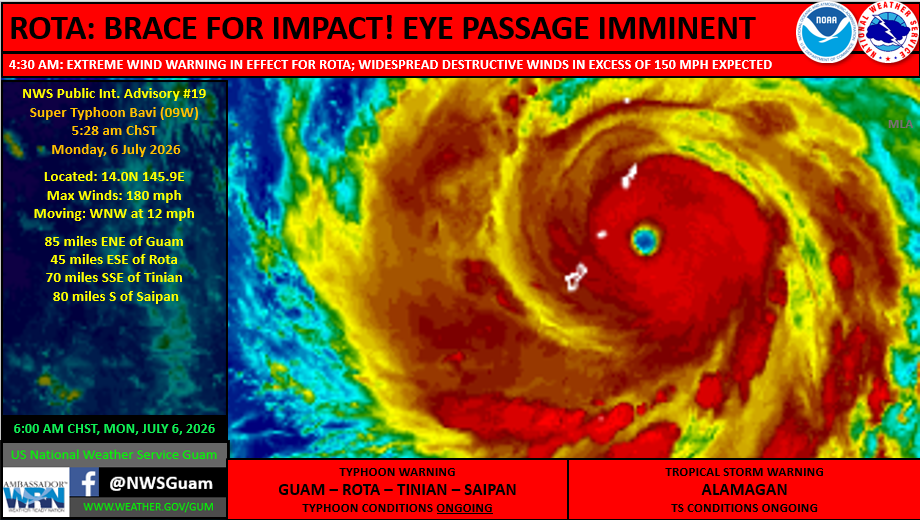
Photo Sources: U.S. National Weather Service Guam
By Christopher Cottrell
July 6, 2026, Federated States of Micronesia__Super Typhoon Bavi’s life-threatening eye over Rota landed with extreme 180 mph winds, according to a warning from the U.S. National Weather Service Guam.
The National Weather Service has just posted this update video.
Still, dangers exist.
They state, “THIS IS AN EXTREMELY DANGEROUS AND LIFE-THREATENING SITUATION! Venturing outside can result in DEATH from flying projectiles. Unreinforced structures will be heavily damaged, if not destroyed. Move immediately into an interior room in your shelter and avoid windward windows, even those that are shuttered as flying debris can puncture and pass through shutters.”
They further warn, “Extreme weather, with torrential rains and potentially catastrophic winds of more than 150 mph, are expected with the impending eye wall as it soon heads on shore of Rota, if it is not already doing so. Eye passage is likely over most of Rota. A period of relative calm will settle in across the island during the passage of the eye. DO NOT VENTURE OUT FROM SAFE SHELTER! As Super Typhoon Bavi proceeds over the island, the eastern side of the eye and the eye wall will soon bring a rapid escalation of winds to potentially catastrophic levels. Being outdoors during this rapid spin-up could be life threatening. Stay in safe shelter. “
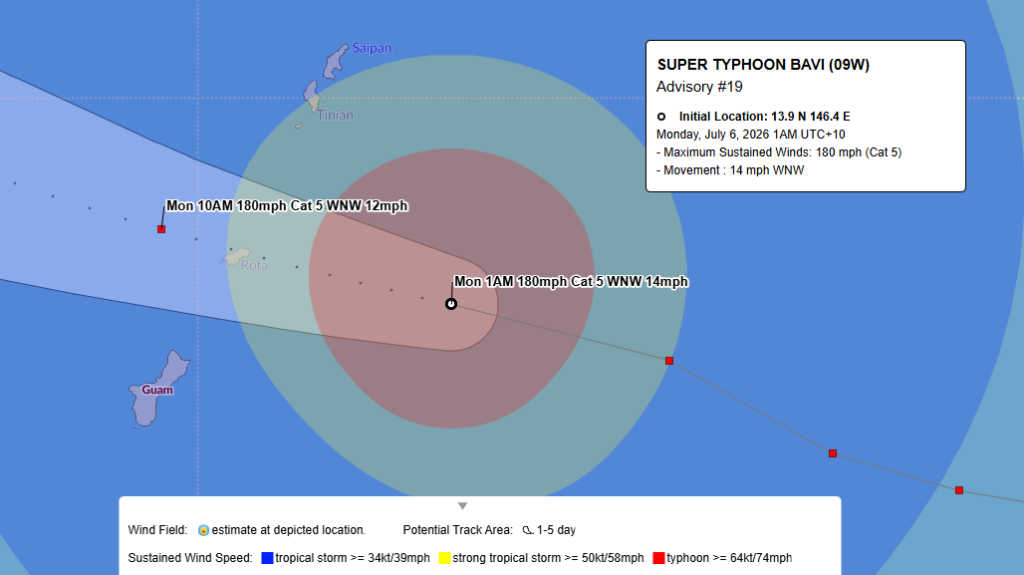
With the extreme wind warning, they sent a press release as of 6:41 am ChST that, “The remainder of this morning will present dangerous, life-threatening conditions for Rota. Peak conditions are ongoing now through noon today for Guam, Tinian and Saipan with these locations experiencing severe tropical storm force to category-1 typhoon force winds.”
They advise to self-shelter in place across Guam and the Commonwealth of the Northern Mariana Islands, urging the public to also:
- Stay out of the water. Building surf and dangerous rip currents are expected along east-facing reefs.
- Secure your gear. Kayaks, paddleboards, jet skis, and small boats that break loose become hazards — and false distress calls.
- Know how to call for help. VHF-FM Channel 16 and 911 — not social media. We don’t monitor Facebook or Instagram for distress. The SOS function on cellular phones is not reliable in this region.
- We do still have VHF outages from Sinlaku, meaning VHF in some areas is limited and may require relay from other operators. Have multiple means of communication, including EPIRBs and PLBs, cellular phones, and satellite phones.
- We do NOT recommend being out on the water going forward until well after the storm passes. If you have reason to be on the water, ensure someone knows where you are going and when you will be back, so they can alert responders if you become overdue!
Micronesia Sun continues to monitor this situation for more reports.
For more information at National Weather Station Guam: weather.gov/gum