 Micronesia Sun Bright News from the Deep Pacific
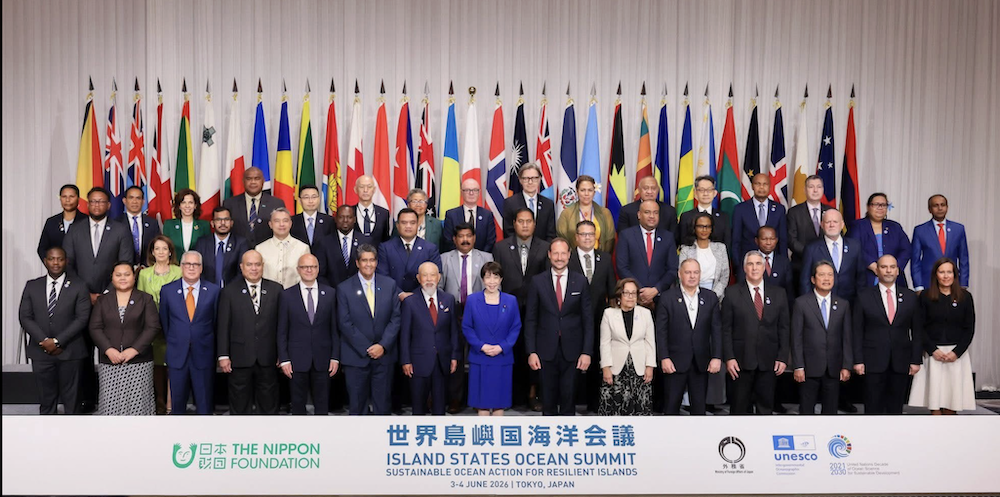
Photo Sources: Office of the President, Republic of Palau, Ministry of Foreign Affairs of Japan
By Christopher Cottrell
June 8, 2026, Palau__The historic Island States Ocean Summit (ISOS) that closed last Thursday in Tokyo, has indelible importance, especially today June 8, World Ocean Day, Palau President Whipps Jr. tells the Micronesia Sun.
As the Co-Chair of The Nippon Foundation, Ministry of Foreign Affairs of Japan, and Intergovernmental Oceanographic Commission of UNESCO supported ISOS meetings, Whipps Jr. was pleased leaving, “Tokyo with something tangible, and practical.”
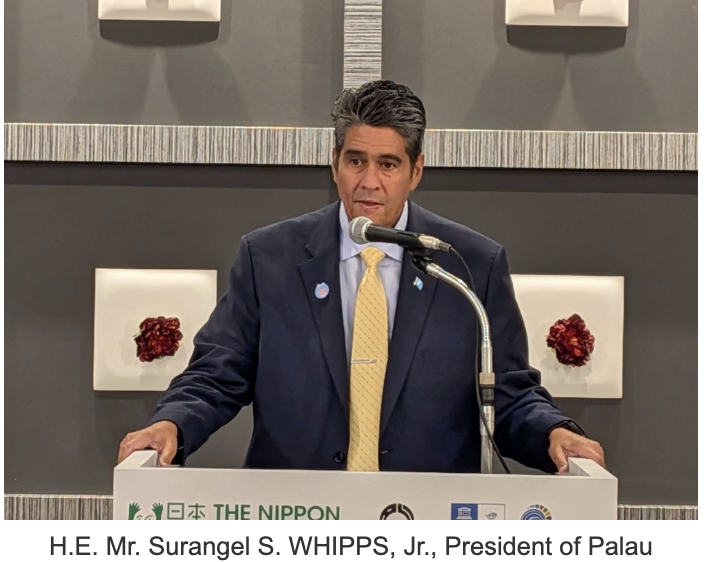
In an interview with the Micronesia Sun, President Whipps Jr. says, “Sustainable ocean planning and management is the key to prosperity for our Islands. When we don’t have proper planning, proper management that’s backed up by science and data, we have problems.”
He continues, “One thing that we learned is that we need to use data and science, and that’s why its so important we have a hub to share and collaborate, and we can work together and find the solutions that optimize the use of our oceans, protect the biodiversity that we have, and provide the economic value to our people that they need to prosper.”
He is referring to the three key successes at ISOS in Tokyo for Palau:
- A new OCEAN HUB platform to sustain partnerships and turn plans into action across all participating nations
- The Nippon Foundation’s commitment of $100 million USD over 10 years through the Ocean States Initiative
- A commitment to hold the Second Island States Ocean Summit in Tokyo in 2031
Whipps Jr.’s office provided the Micronesia Sun with a copy of his closing statements on June 4, 2026:
“My dear friends and co-chairs, Honorary Chairman Dr. Yohei Sasakawa,
Executive Secretary Vidar Helgesen,
Excellencies, Distinguished Leaders, and Children of the Ocean,
We have arrived at the conclusion of this historic Island States Ocean Summit. We have engaged in rich discussions — and now we must turn our absolute focus to the road ahead.
Too often at “inaugural” meetings, we spend days identifying our needs, re-stating our vulnerabilities, and lamenting our crises, yet leave with a beautifully drafted summary that woefully lacks a resourced plan of action.
But this time is different.
The Nippon Foundation, the Government of Japan, and the supporting partners here today did their homework.
They convened us already knowing our challenges. They initiated a foundation for us to shape it into a mechanism that serves the needs of our island states. This time, we leave Tokyo with something tangible, and practical.
In Palau, we are concluding our Marine Spatial Planning process. This informed priorities for our Sustainable Ocean Policy, which will be launched next week.
Through the Marine Spatial Planning process, we worked closely with partners, using science and traditional wisdom to re-assess the Palau National Marine Sanctuary.
Our Sanctuary closed 80% of our EEZ, but it brought unintended consequences. Over the last decade, reef fish populations have declined. It harmed our economic and food security.
It was a great conservation concept, but lacked the balance between protection and production and prosperity.
The Sanctuary is often compared to Palau’s traditional practice of resource management — the bul. A bul is not meant to turn our oceans into a museum where fishing is banned forever.
It is an adaptive management system. Our chiefs would close an area to allow ecosystems to replenish, reopening it only when trusted fishermen say the resources have recovered.
Guided by the bul, and complemented by science, we are bringing Palau National Marine Sanctuary to its full potential, by right-sizing it, and basing conservation and fishing zones on what is both biologically and economically sustainable.
When we launch our Sustainable Ocean Policy the next step will be bringing it to life.
We believe the platform being shaped at this summit is the exact mechanism needed to help all Island States translate our plans into real action.
One example of how this mechanism can further accelerate local efforts is a key initiative Palau is partnering with Japan on.
Together with Japan we are developing the Ngatpang Multi-Purpose Port. This crucial infrastructure ensures that our tourism, aquaculture, and fisheries mutually benefit both the global markets that rely on our tuna, and our people.
The Pacific supplies more than half of the world’s tuna, making our ocean vital to global food security. When you invest in island states’ sustainable ocean management, you are investing in the protection of critical biodiversity and in the future of healthy food systems worldwide.
Effective ocean management cannot stop at our borders. To protect the global ocean, national efforts must be tied to regional and global initiatives, including the Unlocking Blue Pacific Prosperity and the BBNJ.
Excellencies, in just two months, Palau will host the 55th Pacific Islands Forum Leaders Meeting. I fully intend to bring the outcomes we have shaped here in Tokyo straight to the leaders in Palau. To the Government of Japan, the Nippon Foundation, and IOC-UNESCO—thank you for your visionary partnership.
In closing, I want to share a Palauan proverb: Ke di lotkii a Chelechang e diak mletkii a Cherechar.
This proverb comes from a story of a man whose name Cherechar translates to “Future.” He spoke these words to his mother, who thought only of his brother, Chelechang, whose name means “Today.” After being neglected for so long, Cherechar left his family behind. Without his help, the family deeply suffered.
My fellow island leaders, let us not focus only on “Today” and ignore our “Future.” Let us take this momentum home.
Our ocean demands our action and our people deserve our protection. Our children are counting on us to secure their tomorrow.
Thank you, Kom kmal mesulang, and Domo arigatou gozaimasu.”
He also said separately that in two months from August 30 to September 4, 2026, Palau will host the 55th Pacific Islands Forum Leaders Meeting, and that he, “will bring the full outcomes of this Summit directly to our Pacific leaders, many of whom, participated in this conference.”
Over June 3-4, ISOS brought together 35 island nations and over 300 representatives from governments, international organizations, and civil society to chart a new course for the world’s oceans.
Whipps Jr. said at the summit, “In Palau, we say the ocean does not belong to us — we belong to it. Let us leave Tokyo not with just a communiqué, but a plan of action.”